The problem states a<=b<=c. Is GCD(a,a) considered to be equal to 1 when a is prime?
Also, I wonder if the answer for a smaller limit could be posted as an algorithm check.
(Link to problem added by moderator: Problem 276 (View Problem))
Problem 276
Forum rules
As your posts will be visible to the general public you are requested to be thoughtful in not posting anything that might explicitly give away how to solve a particular problem.
This forum is NOT meant to discuss solution methods for a problem.
See also the topics:
Don't post any spoilers
Comments, questions and clarifications about PE problems.
As your posts will be visible to the general public you are requested to be thoughtful in not posting anything that might explicitly give away how to solve a particular problem.
This forum is NOT meant to discuss solution methods for a problem.
In particular don't post any code fragments or results.
Don't start begging others to give partial answers to problems
Don't ask for hints how to solve a problem
Don't start a new topic for a problem if there already exists one
Don't start begging others to give partial answers to problems
Don't ask for hints how to solve a problem
Don't start a new topic for a problem if there already exists one
See also the topics:
Don't post any spoilers
Comments, questions and clarifications about PE problems.
-
harryh
- Posts: 2091
- Joined: Tue Aug 22, 2006 9:33 pm
- Location: Thessaloniki, Greece
-
SynK
- Posts: 1
- Joined: Wed May 20, 2009 6:19 am
Re: Problem 276
Is the GCD function a Greatest Common Denominator, or is it some other function that I should know but cannot think of now? Thanks for the help.
-S
-S
-
hk

- Administrator
- Posts: 12832
- Joined: Sun Mar 26, 2006 10:34 am
- Location: Haren, Netherlands
Re: Problem 276
It is the greatest common divisor.
See: http://en.wikipedia.org/wiki/Greatest_common_divisor
See: http://en.wikipedia.org/wiki/Greatest_common_divisor

War ruins the life and health of untold numbers of innocent children.
-
jvdmeer
- Posts: 2
- Joined: Mon Jan 25, 2010 10:43 pm
- Location: Zoeterneer, Netherlands
Re: Problem 276
If I understand the problem right, we don't have to consider the rule a2+b2=c2.
So a=1, b=1000, c=1000 for example is a valid triangle?
And a=2, b=1000, c=1000 for example is a invalid triangle?
Thanks for the help!
So a=1, b=1000, c=1000 for example is a valid triangle?
And a=2, b=1000, c=1000 for example is a invalid triangle?
Thanks for the help!
-
harryh
- Posts: 2091
- Joined: Tue Aug 22, 2006 9:33 pm
- Location: Thessaloniki, Greece
Re: Problem 276
That rule applies only to right-angle triangles. Problem 276 (View Problem) poses no such restriction.
Yes and yes (for the last two questions).
Yes and yes (for the last two questions).
-
kvom
- Posts: 13
- Joined: Tue Oct 02, 2007 11:06 pm
- Location: Georgia, USA
Re: Problem 276
From the above, it seems that GCD(a,b,c)=1 is not the same as GCD(a,b)=1 AND GCD(b,c)=1
-
harryh
- Posts: 2091
- Joined: Tue Aug 22, 2006 9:33 pm
- Location: Thessaloniki, Greece
Re: Problem 276
No, it is not. The dotted line below gcd(a,b,c) in the problem description, means a tooltip explanation. Hovering your mouse over it, you'll see:
Good luck!
You do not have the required permissions to view the files attached to this post.
-
MacPr1mE
- Posts: 10
- Joined: Tue Dec 29, 2009 1:45 pm
- Location: Germany
Re: Problem 276
If I understood the problem correctly, each side has to be a prime so gcd(a,b,c)=1 ist true, right?
So isn't this assumption wrong?
So isn't this assumption wrong?
jvdmeer wrote:So a=1, b=1000, c=1000 for example is a valid triangle?
And a=2, b=1000, c=1000 for example is a invalid triangle?
-
hk
- Administrator
- Posts: 12832
- Joined: Sun Mar 26, 2006 10:34 am
- Location: Haren, Netherlands
Re: Problem 276
No wrong.MacPr1mE wrote:If I understood the problem correctly, each side has to be a prime so gcd(a,b,c)=1 ist true, right?
Consider gcd(25,49).
25 and 49 have no common factor, so gcd(25,49)=1.
Neither 25 nor 49 is prime.
gcd(a,b,c) should return the gratest common factor of a, b and c.
So gcd(14,21,35)=7, because 14=2*7, 21=3*7 and 35=5*7
But gcd(14,21,36)=1 because 14, 21 and 36 have no common factor.
War ruins the life and health of untold numbers of innocent children.
-
jvdmeer
- Posts: 2
- Joined: Mon Jan 25, 2010 10:43 pm
- Location: Zoeterneer, Netherlands
Re: Problem 276
Just a algorythm-check:
For a max perimeter [le] 100, I get an answer of 6067 triangles with a gcd(a,b,c)=1
For a max perimeter [le] 1000, I get an answer of 5865423 triangles with a gcd(a,b,c)=1
Can someone check this?
For a max perimeter [le] 100, I get an answer of 6067 triangles with a gcd(a,b,c)=1
For a max perimeter [le] 1000, I get an answer of 5865423 triangles with a gcd(a,b,c)=1
Can someone check this?
Last edited by jvdmeer on Thu Feb 04, 2010 1:59 pm, edited 1 time in total.
-
Lord_Farin

- Posts: 239
- Joined: Wed Jul 01, 2009 10:43 am
- Location: Netherlands
Re: Problem 276
I haven't solved the problem, but my algo gives me 6033 such triangles. Also, for p[le]1000, I get 5803431. I would appreciate some feedback.jvdmeer wrote:Just a algorythm-check:
For a max perimeter [le] 100, I get an answer of 6067 triangles with a gcd(a,b,c)=1
Can someone check this?

-
ThomasH
- Posts: 117
- Joined: Sun Mar 26, 2006 8:41 am
- Location: Berlin, Germany
Re: Problem 276
Both values are ok - and both values can easily be brute forced.Lord_Farin wrote:I haven't solved the problem, but my algo gives me 6033 such triangles. Also, for p[le]1000, I get 5803431. I would appreciate some feedback.
-
Jochen_P

- Posts: 55
- Joined: Mon Oct 05, 2009 10:47 am
- Location: Stuttgart, Germany
Re: Problem 276
AHahahaha ... hah .. errr.
I got 23384 for p <= 100 and 23137742 for p <= 1000.
No wonder I am stuck with this
I got 23384 for p <= 100 and 23137742 for p <= 1000.
No wonder I am stuck with this

-
martina_qu
- Posts: 5
- Joined: Wed Feb 05, 2014 7:59 pm
Re: Problem 276
I am surprised to see, that my solution with the primitive triangles does not fit. I applied the Pythagoras-algorithm and counted the trivial ones. I do not understand from the description where is the misconcept. Reading here I get the idea that non-right-triangles might work as well. Are there samples for the triangles which might fit as well? At least one additional sample on the page would have been beneficial. 
-
mpiotte

- Administrator
- Posts: 1961
- Joined: Tue May 08, 2012 5:40 pm
- Location: Montréal, Canada
Re: Problem 276
primitive integer sided triangles example #1: a=1, b=1, c=1martina_qu wrote:I am surprised to see, that my solution with the primitive triangles does not fit. I applied the Pythagoras-algorithm and counted the trivial ones. I do not understand from the description where is the misconcept. Reading here I get the idea that non-right-triangles might work as well. Are there samples for the triangles which might fit as well? At least one additional sample on the page would have been beneficial.
primitive integer sided triangles example #2: a=6, b=10, c=15

-
martina_qu
- Posts: 5
- Joined: Wed Feb 05, 2014 7:59 pm
Re: Problem 276
Sorry, but now I completely off the track. Under triangle I understand a geometric figure with three different corners `which are located anywhere in a (x,y) coordinate-system. And the distance between the so called corners is named length and they are individually named by a,b,c. Additionally the name tri-angle refers to the fact of a geometric figure enclosing 3 angles.
The sample with a=1, b=1, c=1 cannot be constructed unless it is a straight line. But then it fails to have 3 different edges. And therefore cannot be called triangle.
And the sample with 6,10,15 can also not be constructed geometrically as a triangle.
So, what is it, that you call triangle?
The sample with a=1, b=1, c=1 cannot be constructed unless it is a straight line. But then it fails to have 3 different edges. And therefore cannot be called triangle.
And the sample with 6,10,15 can also not be constructed geometrically as a triangle.
So, what is it, that you call triangle?
-
TripleM
- Posts: 384
- Joined: Fri Sep 12, 2008 3:31 am
Re: Problem 276
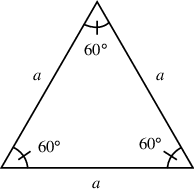
Here is a triangle where all three sides are the same length. Let this length be 1. Then you have a triangle with a=b=c=1.
-
martina_qu
- Posts: 5
- Joined: Wed Feb 05, 2014 7:59 pm
Re: Problem 276
Thx for the picture  As it says, one pic says more then 1000 words. May I suggest to update the question in that sense, that you provide at least the information you have posted here? i.e. the two tuples (1,1,1) [+pic?] and (6,5,10) cause the first is so trivial one might skip it as well as there exists no right-corners triangles as well. Perhaps you could also add the triple (6,6,11).
I am aware that these information might not get into the direction of solution but would help to have a clear understanding what might be requested and which thinking-lapsus could be avoided. At least this would have helped me a lot.
As it says, one pic says more then 1000 words. May I suggest to update the question in that sense, that you provide at least the information you have posted here? i.e. the two tuples (1,1,1) [+pic?] and (6,5,10) cause the first is so trivial one might skip it as well as there exists no right-corners triangles as well. Perhaps you could also add the triple (6,6,11). I am aware that these information might not get into the direction of solution but would help to have a clear understanding what might be requested and which thinking-lapsus could be avoided. At least this would have helped me a lot.
-
hk
- Administrator
- Posts: 12832
- Joined: Sun Mar 26, 2006 10:34 am
- Location: Haren, Netherlands
Re: Problem 276
Why shoudn't there exist right corner triangles?
Take for instance the triangle (3,4,5).
I think you have to update your notion what a triangle is.
Here's a page to begin with Wikipedia
Take for instance the triangle (3,4,5).
I think you have to update your notion what a triangle is.
Here's a page to begin with Wikipedia
War ruins the life and health of untold numbers of innocent children.